


Metroid Prime 4: Beyond
Posted In: Video Games | 29 Dec 2025
After 18 years, Nintendo finally released a fourth game in the Metroid Prime series. Or I guess 6th if you consider Metroid Prime Pinball and Metroid Prime Hunters to be just as much part of the group rather than spins-off and supplementary material. Despite a rocky development (that apparently included scrapping and restarting) and a lot of radio silence during Nintendo Directs, Metroid Prime 4 persevered and hit store shelves with plenty of time to spare before Christmas.
As something of a modest Metroid fan myself (I mean, Samus Aran has only been my social media icon for what? Years?), I obviously had to buy a copy and step back into a world I hadn't seen since half my life ago.
But was it worth the wait? Was it everything I hoped it would be? Truthfully, I'm not entirely sure. After some brief consideration, I think I can sum up my entire opinion of the game in a single, two-word sentence:
But why?
Though before we get into that, let's start off on a high note:
The Good
No matter what, Prime 4 is inarguably a Prime game. It's a first-person platformer-shooter with a heavy emphasis on exploration, item collection, upgrade-based progression, backtracking, and thirty quintillion things to scan with your handy-dandy Scan Visor. It is, on a mechanical level, correctly what it should be.
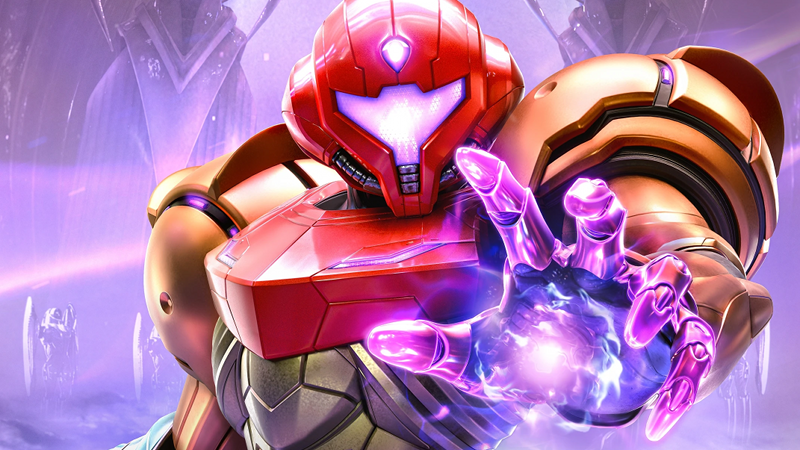
Visually, Prime 4 (transparency note: Switch 2 Edition) is beautiful. I do mean that in a literal sense, as the game has stunning landscapes, intriguing architectural and biological designs, and some lovely environmental reactions (like Samus's arm cannon frosting over in cold environments). More than that, I also mean it in the sense of being stylistically pious. Existing designs remain recognizable, only touched up and made higher fidelity. Everything new to the game feels "Metroid-y enough" that I don't find myself thinking Samus was pasted into some other game.
Musically, Prime 4 is consistent. Same familiar jingles, same "choirs and electronic instrumentals" vibe to the soundtrack I've come to expect and love. Admittedly, that's a very shallow opinion (and that's on me), but sometimes all that really matters is "the game sounds right". And Prime 4 definitely sounds right.
There's always the worry that, after such a long time, a new entry to a franchise will either be completely alien to its predecessors or a fine example of missing the point. As control of development changes hands and the passing of time changes tastes, it's inevitable that fresh blood brings fresh perspective, and the unfortunate nature of fresh perspective is that it's just as likely to be combative or ignorant as it is innovative. Often enough, the new guy comes in and throws out all the existing framework because it's passé, or because he just doesn't like it. Or a new guy comes in intent on replicating the masters before him, but he doesn't understand why the masters did what they did, so everything he makes is a hollow off-model "Temu" knock-off. And now all your superheroes are grimdark edgelords, and your scary invincible aliens built up over the course of the film are now overpowered mooks that get gunned down by the handfuls. Yay. *ahem*
Fortunately, Retro Studios et al. kept faithful to what matters the most, and did well to retain that critical core familiarity. I went into the game expecting Prime and I came out of it having played Prime, and that's just swell. Yes, I am genuinely awarding merit for that, given we're in the middle of a giant ocean of creative disrespect and disregard.
But... that doesn't mean they did everything right.
The "But Why?"
Metroid Prime is a series where the story is divided between plot that's directly told to you and lore/world-building only made apparent by scanning objects and entities.
Typically, however, the latter is supposed to be optional flavor. If you're curious about something in the moment, you have an opportunity to learn more. If you're not, there's no penalty for not scanning it (lack of enemy hints and game completion percentage notwithstanding). There might be some bits of the story that remain a mystery if you neglect to scan things, but you're not left scratching your head cluelessly. You always have a decent idea of what's going on and why. The games won't throw you into a cutscene where the Big Bad rants about how arrogant you are to claim the mantle of legendary fupplelarg and endeavor to quintlfip the smoosbot, and you have zero idea what the hell they're talking about because you didn't scan all the funnily shaped rocks dotted around the planet.
But, contrarily, that's exactly how Prime 4 feels. As I progressed through the story, things kept happening with very little rhyme or reason:
And the few times I did gain some clarification, it was because I explored the whole darn map and scanned some optional statues!
To be clear, I scanned a bunch of things over the course of my playthrough. I had over 70% scan completion by the end. Yet, I walked away with only a vague sense of having fulfilled a mildly coercive quid pro quo --helping out a possibly long-extinct species in exchange for a way home-- and little else. Everything else is a mystery.
Thus "okay, but why?"
Prime 4 was a potential story that was rudely interrupted by a detour that, itself, was rudely interrupted by several other detours. (Perhaps "detour" is a terribly ironic word to use for a game that is, by design, meant to be full of backtracking.) Every bit of progression brought an implied promise of context, but rarely did that promise ever feel fulfilled.
Perhaps that's entirely my fault because I didn't sit there and do my full assigned reading. I didn't get 100% scans after all. And I didn't sit and read through all the "extra lore" bits that are relegated to the pause menu logbook, only what's upfront displayed in the scan visor. Maybe "Problem Exists Between TV And Couch". Seriously, though. What kind of game throws you into a story and then doesn't directly tell you any of it if you don't go out of your way to dig it up?
...
Ah, right, Breath of the Wild. But I'd like to think there's a meaningful difference between "sandbox with optional plot" and whatever this was.
Oh well.
The "Not Actually That Bad"
I know some people had (or still have) reservations about the Vi-O-La motorcycle and the "open world" part of the game. Personally, I don't mind them. I think they're fine.
Thinking back on the first two Prime games, I feel like backtracking was genuinely tedious. There were some shortcuts between areas, but in general it was very "walking simulator" with an unhealthy dose of slow movement and repeated re-encounters with all the obstacle enemies. The third game tried to reduce the tedium by breaking the world into smaller vignettes that you could travel between via ship, but I think all that really did was replace "walking simulator" with "waiting simulator" due to all the cutscenes and loading screens associated with flying place to place.
The motorcycle-traveled world of Viewros, however, feels like a well-done psychological trick. The desert is just big enough and populated enough to whet your appetite for exploration but just small enough that travel time from major area to major area doesn't feel particularly long. And if there isn't something to look at, there's often at least a couple things to dodge or shoot at. It's a bit like a fairly well-crafted mini-game that distracts you ever so slightly. I think that deserves a bit of praise just for nailing that happy medium.
I also know some people had issues with the Galactic Federation NPCs. I honestly don't see it. They had interesting personalities, charming interactions, and added some garnish to an otherwise empty environment. At no point did it feel like they were there to hold my hand or drag me through the puzzles if I didn't solve them in 0.5 nanoseconds. At no point did I feel like they were genuinely holding me back, either. Sure, MacKenzie is sometimes a bit overbearing with the reminders, but hardly a deal-breaker.
It really is fun to eavesdrop on base camp conversations. I loved listening to Armstrong and MacKenzie talk about push-up count. "Four sets? Not bad!" "No, four push-ups. In sets of one." I feel that, Mac. I feel that in my soul.
I'm also quite fond of Tokabi's talks about "Sollan". It's a pleasant change to see bits and pieces of human culture and world-building in a franchise that otherwise doesn't invest that much into its human characters. It makes characters feel more alive!
Lastly, I myself was initially concerned that the game yet again included a secondary ammo system. I will definitely always have some lingering PTSD from Prime 2's ammo system with the Light and Dark Beams. Yet, as I kept playing, I found the game handing out ammo expansions like candy and, by the end, I had over 400 secondary ammo. Add to that the change to Save Stations refilling all your ammo, too, and my worries largely melted away.
It's always nice when things are better than expected.
The "Actually That's Kind Of Bad"
Unfortunately, despite pulling off some potentially questionable choices, Prime 4 did commit a handful of technical fouls with other things I wouldn't ordinarily expect to be gotten wrong.
And Lastly, The "That's... Weird"
Prime 4 also has a few things I'm not quite willing to call "bad" because they don't offend my subjective sensibilities or ruin my experience, but they're certainly creative decisions that were made.
Wrapping Up
I won't be dishonest. This game is very much "does as says on tin". It looks like a Metroid Prime and it plays like a Metroid Prime. If that's all you really want, then this is the game for you. But if you're expecting an enriching narrative and a fulfilling "metroidvania" experience, I think you're probably going to walk away dissatisfied.
Prime 4 asks more questions than it answers. If it's meant to be a stinger to a greater multi-part series, then it's certainly an amuse-bouche of plot threads. Sadly, it leaves an aftertaste just unpalatable enough to undermine the possibility of actually getting there. I don't find myself excitedly thinking "I can't wait for Prime 5!", just lamenting the possibility that Prime is now dead for real. Of course, I may just be pessimistic.
Prime 4 makes a number of questionable choices in how it gatekeeps the player and guides their progress. Metroid has always been a series that's intrinsically repetitive, yet this time around the repetition feels lazy and unrewarding. What's truly new doesn't matter, and what does matter isn't particularly interesting narratively or mechanically.
Prime 4 is a utilitarian approach to the series. Go here, do this, go there, do that. Detour from A to B to get the thing you need to complete A and return. Once you can go anywhere and do anything, you might just find you've already gone everywhere and done everything. I honestly don't see myself replaying this game any time soon.
It's possible that time and rose-tinted glasses have persuaded me into thinking of the franchise as something greater than it is. Perhaps Metroid has always been this superficially stupid and I've unfairly changed my grading rubric. But for the second of two games that took forever to come out, aren't I at least a little bit justified in expecting better? To otherwise accept that it was difficult to make another schlock in a long line of schlock feels like the mother of all ignominies.
I'm not going to give this game a numeric rating. I don't even know how to begin to calculate that. If you just want some familiar Prime feel, then go ahead and play it. If you're looking for a genuinely interesting experience, then give it a pass.
Posted In: Video Games | 29 Dec 2025
After 18 years, Nintendo finally released a fourth game in the Metroid Prime series. Or I guess 6th if you consider Metroid Prime Pinball and Metroid Prime Hunters to be just as much part of the group rather than spins-off and supplementary material. Despite a rocky development (that apparently included scrapping and restarting) and a lot of radio silence during Nintendo Directs, Metroid Prime 4 persevered and hit store shelves with plenty of time to spare before Christmas.
As something of a modest Metroid fan myself (I mean, Samus Aran has only been my social media icon for what? Years?), I obviously had to buy a copy and step back into a world I hadn't seen since half my life ago.
But was it worth the wait? Was it everything I hoped it would be? Truthfully, I'm not entirely sure. After some brief consideration, I think I can sum up my entire opinion of the game in a single, two-word sentence:
But why?
Though before we get into that, let's start off on a high note:
The Good
No matter what, Prime 4 is inarguably a Prime game. It's a first-person platformer-shooter with a heavy emphasis on exploration, item collection, upgrade-based progression, backtracking, and thirty quintillion things to scan with your handy-dandy Scan Visor. It is, on a mechanical level, correctly what it should be.
Visually, Prime 4 (transparency note: Switch 2 Edition) is beautiful. I do mean that in a literal sense, as the game has stunning landscapes, intriguing architectural and biological designs, and some lovely environmental reactions (like Samus's arm cannon frosting over in cold environments). More than that, I also mean it in the sense of being stylistically pious. Existing designs remain recognizable, only touched up and made higher fidelity. Everything new to the game feels "Metroid-y enough" that I don't find myself thinking Samus was pasted into some other game.
Musically, Prime 4 is consistent. Same familiar jingles, same "choirs and electronic instrumentals" vibe to the soundtrack I've come to expect and love. Admittedly, that's a very shallow opinion (and that's on me), but sometimes all that really matters is "the game sounds right". And Prime 4 definitely sounds right.
There's always the worry that, after such a long time, a new entry to a franchise will either be completely alien to its predecessors or a fine example of missing the point. As control of development changes hands and the passing of time changes tastes, it's inevitable that fresh blood brings fresh perspective, and the unfortunate nature of fresh perspective is that it's just as likely to be combative or ignorant as it is innovative. Often enough, the new guy comes in and throws out all the existing framework because it's passé, or because he just doesn't like it. Or a new guy comes in intent on replicating the masters before him, but he doesn't understand why the masters did what they did, so everything he makes is a hollow off-model "Temu" knock-off. And now all your superheroes are grimdark edgelords, and your scary invincible aliens built up over the course of the film are now overpowered mooks that get gunned down by the handfuls. Yay. *ahem*
Fortunately, Retro Studios et al. kept faithful to what matters the most, and did well to retain that critical core familiarity. I went into the game expecting Prime and I came out of it having played Prime, and that's just swell. Yes, I am genuinely awarding merit for that, given we're in the middle of a giant ocean of creative disrespect and disregard.
But... that doesn't mean they did everything right.
The "But Why?"
Metroid Prime is a series where the story is divided between plot that's directly told to you and lore/world-building only made apparent by scanning objects and entities.
Typically, however, the latter is supposed to be optional flavor. If you're curious about something in the moment, you have an opportunity to learn more. If you're not, there's no penalty for not scanning it (lack of enemy hints and game completion percentage notwithstanding). There might be some bits of the story that remain a mystery if you neglect to scan things, but you're not left scratching your head cluelessly. You always have a decent idea of what's going on and why. The games won't throw you into a cutscene where the Big Bad rants about how arrogant you are to claim the mantle of legendary fupplelarg and endeavor to quintlfip the smoosbot, and you have zero idea what the hell they're talking about because you didn't scan all the funnily shaped rocks dotted around the planet.
But, contrarily, that's exactly how Prime 4 feels. As I progressed through the story, things kept happening with very little rhyme or reason:
- Why was Sylux warring with the Federation?
- Where did those parasitizing metroids came from? How are they also on Viewros?
- Was ending up on Viewros a complete accident or some intentional conspiracy?
- If Viewros is isolated in such a way that you can't just stumble upon it, why was the Master Teleporter locked up? If you can't get in, why make it hard to get out? What does the enormous labor of finding and fighting for the keys have to do with preserving the Lamorn legacy?
- Why am I somehow able to heal Gal Fed allies with the psychic visor?
- Why were there robots pretending to be Sylux?
- What exactly was Sylux doing the entire time, why was he in a healing pod in Chrono Tower at the end of the game, and where did all those powers come from?
- Why did Samus keep getting bombarded with Sylux's singular obsessive memory?
- Why does Sylux even have beef with Samus? His failures are his own. The blood on his hands is his own fault. Is he just throwing a tantrum out of an unfounded sense of righteous indignation?
- What even was that final boss arena?
- How did Samus get back from the final boss arena?
- Why was any of that ending even necessary? It just feels like unnecessary cruelty to make Sylux matter more than he did.
And the few times I did gain some clarification, it was because I explored the whole darn map and scanned some optional statues!
To be clear, I scanned a bunch of things over the course of my playthrough. I had over 70% scan completion by the end. Yet, I walked away with only a vague sense of having fulfilled a mildly coercive quid pro quo --helping out a possibly long-extinct species in exchange for a way home-- and little else. Everything else is a mystery.
Thus "okay, but why?"
Prime 4 was a potential story that was rudely interrupted by a detour that, itself, was rudely interrupted by several other detours. (Perhaps "detour" is a terribly ironic word to use for a game that is, by design, meant to be full of backtracking.) Every bit of progression brought an implied promise of context, but rarely did that promise ever feel fulfilled.
Perhaps that's entirely my fault because I didn't sit there and do my full assigned reading. I didn't get 100% scans after all. And I didn't sit and read through all the "extra lore" bits that are relegated to the pause menu logbook, only what's upfront displayed in the scan visor. Maybe "Problem Exists Between TV And Couch". Seriously, though. What kind of game throws you into a story and then doesn't directly tell you any of it if you don't go out of your way to dig it up?
...
Ah, right, Breath of the Wild. But I'd like to think there's a meaningful difference between "sandbox with optional plot" and whatever this was.
Oh well.
The "Not Actually That Bad"
I know some people had (or still have) reservations about the Vi-O-La motorcycle and the "open world" part of the game. Personally, I don't mind them. I think they're fine.
Thinking back on the first two Prime games, I feel like backtracking was genuinely tedious. There were some shortcuts between areas, but in general it was very "walking simulator" with an unhealthy dose of slow movement and repeated re-encounters with all the obstacle enemies. The third game tried to reduce the tedium by breaking the world into smaller vignettes that you could travel between via ship, but I think all that really did was replace "walking simulator" with "waiting simulator" due to all the cutscenes and loading screens associated with flying place to place.
The motorcycle-traveled world of Viewros, however, feels like a well-done psychological trick. The desert is just big enough and populated enough to whet your appetite for exploration but just small enough that travel time from major area to major area doesn't feel particularly long. And if there isn't something to look at, there's often at least a couple things to dodge or shoot at. It's a bit like a fairly well-crafted mini-game that distracts you ever so slightly. I think that deserves a bit of praise just for nailing that happy medium.
I also know some people had issues with the Galactic Federation NPCs. I honestly don't see it. They had interesting personalities, charming interactions, and added some garnish to an otherwise empty environment. At no point did it feel like they were there to hold my hand or drag me through the puzzles if I didn't solve them in 0.5 nanoseconds. At no point did I feel like they were genuinely holding me back, either. Sure, MacKenzie is sometimes a bit overbearing with the reminders, but hardly a deal-breaker.
It really is fun to eavesdrop on base camp conversations. I loved listening to Armstrong and MacKenzie talk about push-up count. "Four sets? Not bad!" "No, four push-ups. In sets of one." I feel that, Mac. I feel that in my soul.
I'm also quite fond of Tokabi's talks about "Sollan". It's a pleasant change to see bits and pieces of human culture and world-building in a franchise that otherwise doesn't invest that much into its human characters. It makes characters feel more alive!
Lastly, I myself was initially concerned that the game yet again included a secondary ammo system. I will definitely always have some lingering PTSD from Prime 2's ammo system with the Light and Dark Beams. Yet, as I kept playing, I found the game handing out ammo expansions like candy and, by the end, I had over 400 secondary ammo. Add to that the change to Save Stations refilling all your ammo, too, and my worries largely melted away.
It's always nice when things are better than expected.
The "Actually That's Kind Of Bad"
Unfortunately, despite pulling off some potentially questionable choices, Prime 4 did commit a handful of technical fouls with other things I wouldn't ordinarily expect to be gotten wrong.
- The game lets you play "dual stick" style, but I feel like the game wasn't actually designed with that in mind. When you lock on to an enemy, you can only lock on to their center of mass, yet plenty of enemies have parts you have to shoot at that are very distinctly not the center of mass. I genuinely struggled to perform that "sub" aiming using dual sticks, especially when I'm moving and dodging and weaving. I tried enabling gyro aiming, but that didn't help much as it felt like my controller didn't want to respond to tilting and tilting didn't seem any more precise anyway. Maybe it's just my fault for docking the Joycons 2 in the grip? But I don't think the game ever said not to do that. Possibly, I just needed to keep fiddling with sensitivity settings. I'm not sure where the line is between "me problem" and "game problem" on that one.
- Samus's new suit upgrades feel effectively pointless. The Vi-O-La suit only serves one purpose: it lets you use the Vi-O-La. Technically yes, that's a mechanically "kosher" decision. Suit upgrades are supposed to open up the amount of explorable terrain (be it via "you can now go there" or "you can now traverse there more easily") and you can't really deny this is a form of that. But there's something legitimately vulgar about needing an entire suit upgrade to even begin exploring in earnest in the first place. It should be "now you can go there", not "now you can actually go somewhere" --especially when you spend more time off the bike than on.
If that weren't bad enough, the next suit upgrade is even less useful. The Vi-O-La IC suit does absolutely nothing except allow the Vi-O-La to travel over lava. Which is great until you realize there are only like three uses in Flare Pool for that (unless you decide to make return trips later).
(Side Note: If you're tempted to point at Prime 2's Dark Suit and Prime 3's Hazard Shield as examples of previous games already doing these things, please keep in mind that the Dark Suit is constantly in use because half that game takes place in Dark Aether, and that the Hazard Shield at least also protects against Fuel Gel and so isn't entirely a Pirate Home World maguffin.) - The final Legacy suit is completely narratively irrelevant. It serves no greater purpose except to let you spend 35 missile ammo to create a temporary barrier. The reason it does that is effectively "just because".
What exactly does the Legacy suit have to do with the Lamorn's legacy? Nothing. It's not necessary for the Master Teleporter. It doesn't unlock any additional fast travel or Vi-O-La features. It doesn't really even symbolize anything iconic like wearing the garb of the Chosen One. - The game combines the psychic and scan visors. Frustratingly, this means there are times where I want to do one thing, but the visor does another --often because it's snapping to the wrong thing.
- Mandatory green crystal farming in order to beat the game. (At least the game gives them generously but wow.)
- It feels like the game relies on way too many battles that are "hey, here's a crap-tonne of Grievers, have fun, good luck, don't die, and don't let your Gal Fed buddy die either".
- Either let me heal allies before they're downed or don't make it a race against the clock to res them before they actually die-die from additional damage.
- Tokabi can be at one of a number of camp locations in Sol Valley. At each camp, you get an item for talking with him. The item radar will mark each of these locations where you've not yet received an item with a generic "unacquired item" icon regardless if he's physically there or not. If you don't know this, you will spend an eon looking for something that isn't there (yet).
- Fighting anything while on the Vi-O-La is a miserable experience. It's tedious due to the slow rate of fire of the psychic doohickey.
- The game tells you to look out for mech parts, and then ignores letting you do anything about the mech parts until the very end when it finally randomly gives you the ability to do something about the mech parts.
- Needing MacKenzie's help to turn certain collected items into actual equipment upgrades feels outright antithetical to the entire shtick of the power suit being able to integrate anything and everything.
And Lastly, The "That's... Weird"
Prime 4 also has a few things I'm not quite willing to call "bad" because they don't offend my subjective sensibilities or ruin my experience, but they're certainly creative decisions that were made.
- Samus seems to languish in pain when her energy is low. I know her power suit is part of her biologically, but it doesn't feel correct to treat low shield energy as a form of physical injury.
Considering there's already an alarm bell and visual message for shield energy being low, I don't even see a mechanical reason for including it (e.g., a diegetic way of conveying critical status). It's just an odd, mismatched garnish on top of an otherwise stoic protagonist.
- There is a battle early in Ice Belt where apparently you're meant to lose. Countless snow wolves attack you, but no matter how many you kill, they just keep coming until your suit's energy is reduced to 1. Tokabi then drives them off with a giant gun and the story proceeds. Maybe you can also trigger story progression by not being awful at the game and actually killing enough of them? But that doesn't change the fact that losing the fight is a legitimate option.
Unwinnable battles might not be new to video games as a whole, but it's unprecedented in Metroid. The closest thing to it that the series has done before was the giant metroid in Super draining all your energy down to 1, but it's hardly the same. It's not a cutscene given that "Baby Skip" is a thing, but it's arguably not even a fight either since it nominally happens near-instantly with little option for meaningful resistance. The shock and awe goes as quickly as it comes.
In contrast, my experience of the snow wolf battle was me enduring a long, drawn-out loss where I kept thinking "I guess I'm just gonna die and have to do this over again, huh?" and wondering if the game was somehow penalizing me for not having enough Fire Shot ammo or being bad at combat. - Green Energy is kind of just Phazon again, isn't it? It doesn't seem to possess any innately dangerous qualities to Samus, but it's the source of a lot of enemy power and mutations. I'm calling this weird rather than bad because powerful energy that's green and crystalline is kind of appealing to me as a mecha fan (I'm all too fond of Getter Rays, G-Stone energy, etc.) so I'm only minorly baffled that they elected to continue the franchise maguffin under a new name and color.
- Why is every replacement equipment "psychic"? I understand that Samus has psychic powers now for some reason, but why does that mean everything is an expression of the same nebulous "psychic power"? My beam, bombs, and power bombs are all psychic energy. My boots are inexplicably psychic. My grapple beam is somehow psychic.
I know the Lamorn transitioned away from being an industrial species, but it feels like they took advantage of a bargain sale at CostCo and had to find a use for thirty five pounds of apples before they went bad. And so, rather than each upgrade bringing neat lore drops hinting into the nature of the Lamorn age of industry, it's just "psychic power" this and that. - After the intro part of the game, you will never see Samus's ship ever again. It's not actually a form of Chekhov's Gun, but it sure does feel like a form of Chekhov's Gun. Wouldn't it at least have been cool to discover the ship and use that to transport mech parts back to base camp?
- And, uh... Did anybody else get the distinct feeling that Lamorn architecture is gynic in design? So many doors feel vulva-shaped --especially those with the pull-down psychic crystal lock.
Wrapping Up
I won't be dishonest. This game is very much "does as says on tin". It looks like a Metroid Prime and it plays like a Metroid Prime. If that's all you really want, then this is the game for you. But if you're expecting an enriching narrative and a fulfilling "metroidvania" experience, I think you're probably going to walk away dissatisfied.
Prime 4 asks more questions than it answers. If it's meant to be a stinger to a greater multi-part series, then it's certainly an amuse-bouche of plot threads. Sadly, it leaves an aftertaste just unpalatable enough to undermine the possibility of actually getting there. I don't find myself excitedly thinking "I can't wait for Prime 5!", just lamenting the possibility that Prime is now dead for real. Of course, I may just be pessimistic.
Prime 4 makes a number of questionable choices in how it gatekeeps the player and guides their progress. Metroid has always been a series that's intrinsically repetitive, yet this time around the repetition feels lazy and unrewarding. What's truly new doesn't matter, and what does matter isn't particularly interesting narratively or mechanically.
Prime 4 is a utilitarian approach to the series. Go here, do this, go there, do that. Detour from A to B to get the thing you need to complete A and return. Once you can go anywhere and do anything, you might just find you've already gone everywhere and done everything. I honestly don't see myself replaying this game any time soon.
It's possible that time and rose-tinted glasses have persuaded me into thinking of the franchise as something greater than it is. Perhaps Metroid has always been this superficially stupid and I've unfairly changed my grading rubric. But for the second of two games that took forever to come out, aren't I at least a little bit justified in expecting better? To otherwise accept that it was difficult to make another schlock in a long line of schlock feels like the mother of all ignominies.
I'm not going to give this game a numeric rating. I don't even know how to begin to calculate that. If you just want some familiar Prime feel, then go ahead and play it. If you're looking for a genuinely interesting experience, then give it a pass.